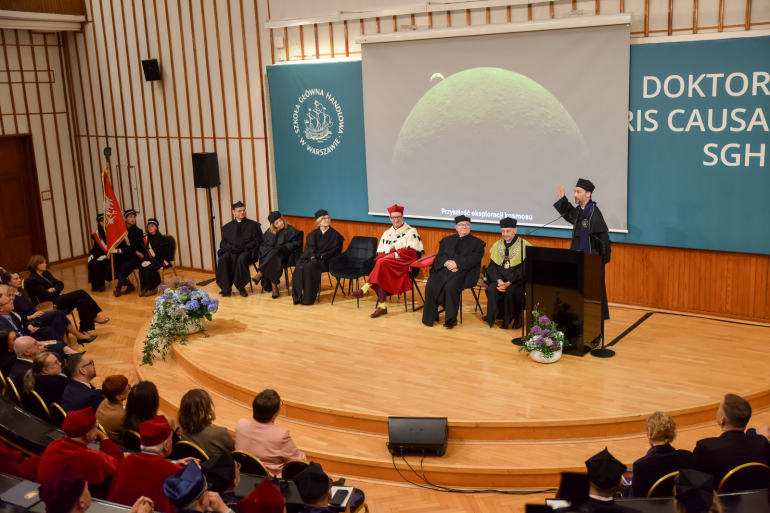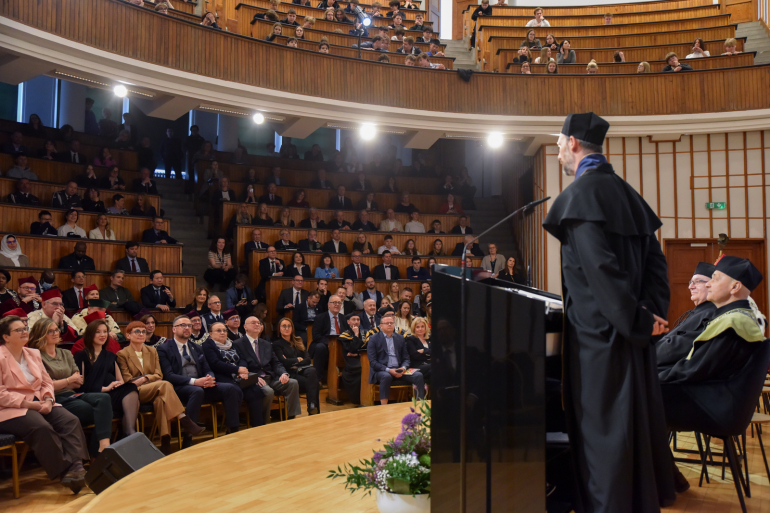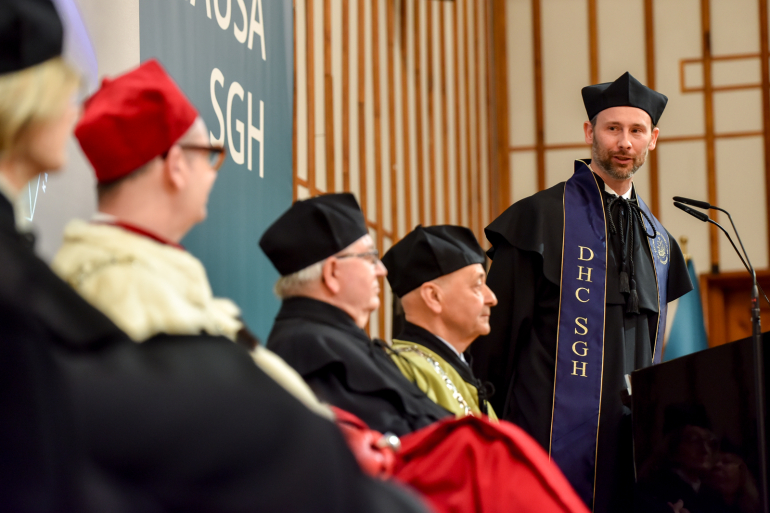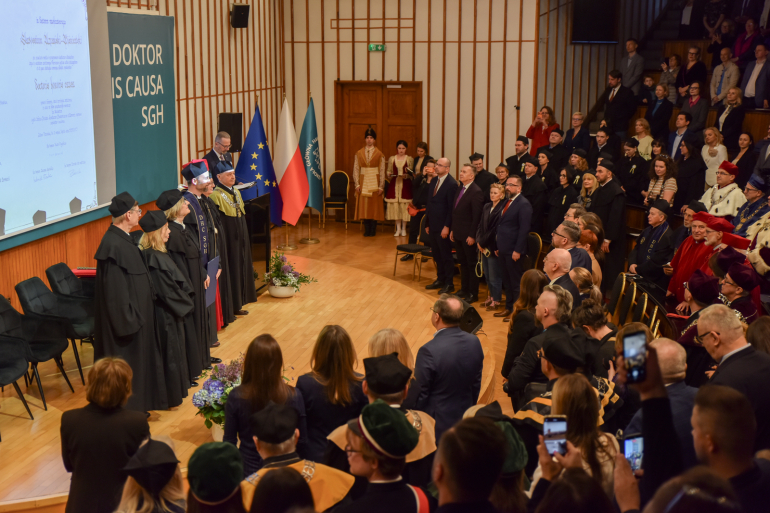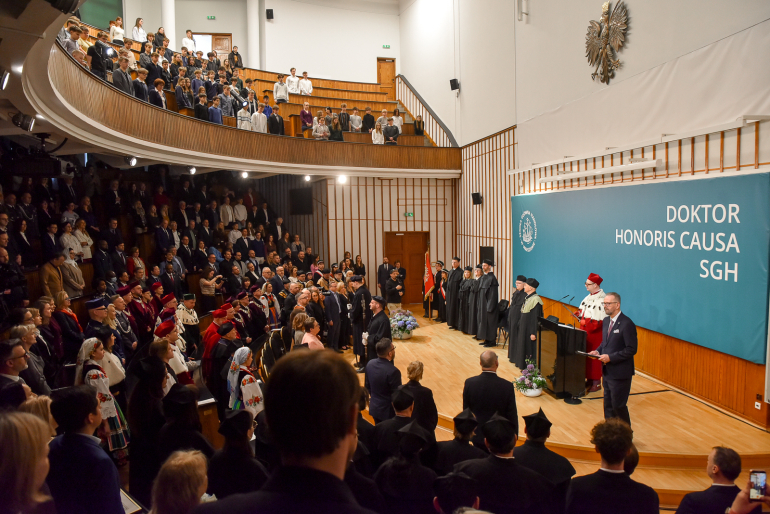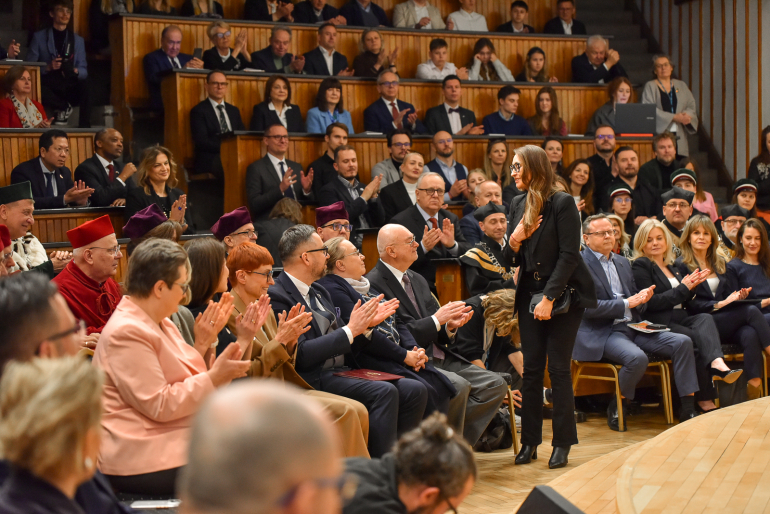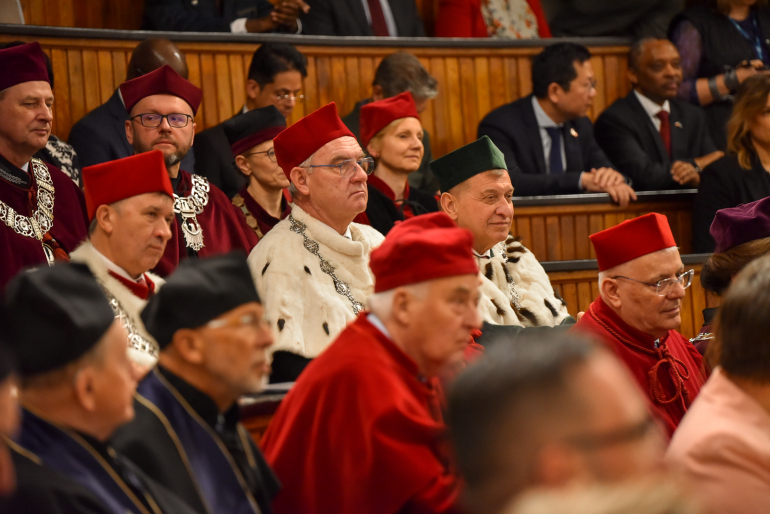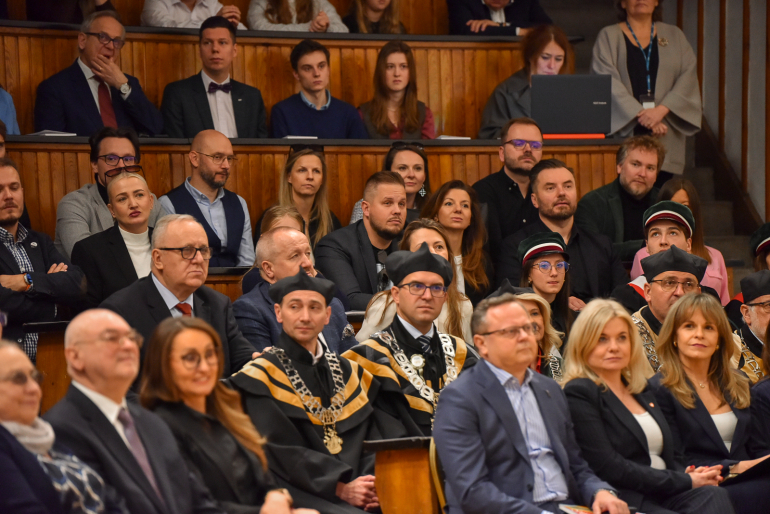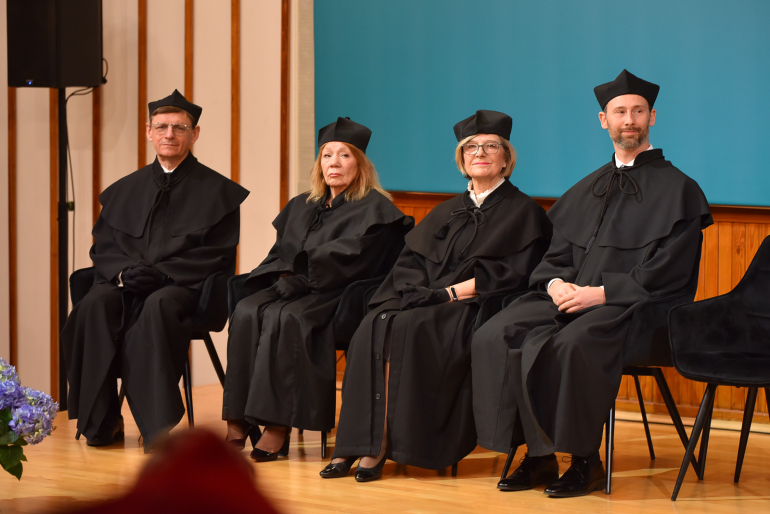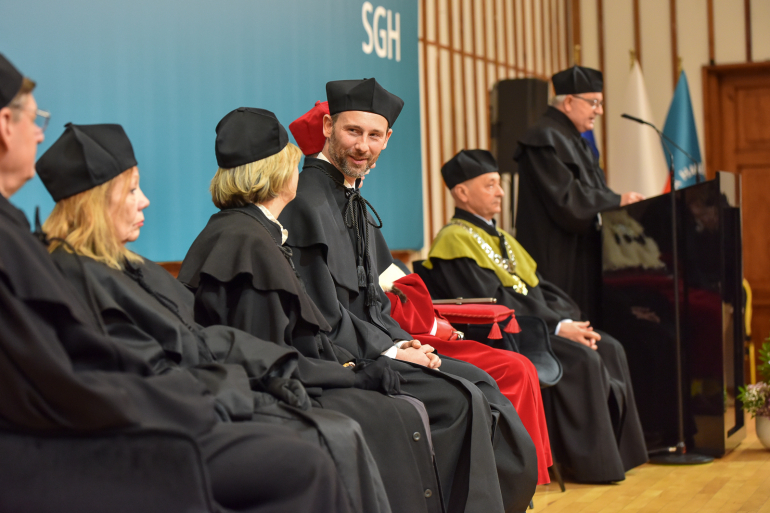
Ceremonial awarding of the honorary doctorate diploma of SGH to Dr Eng. Sławosz Uznański-Wiśniewski
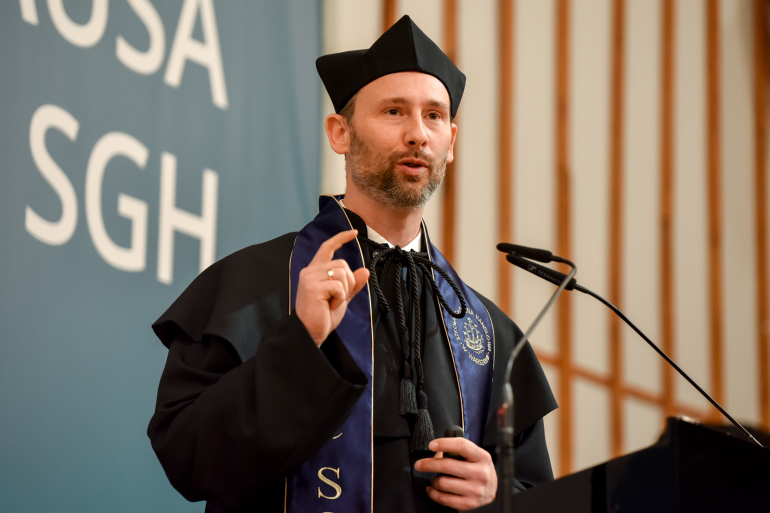
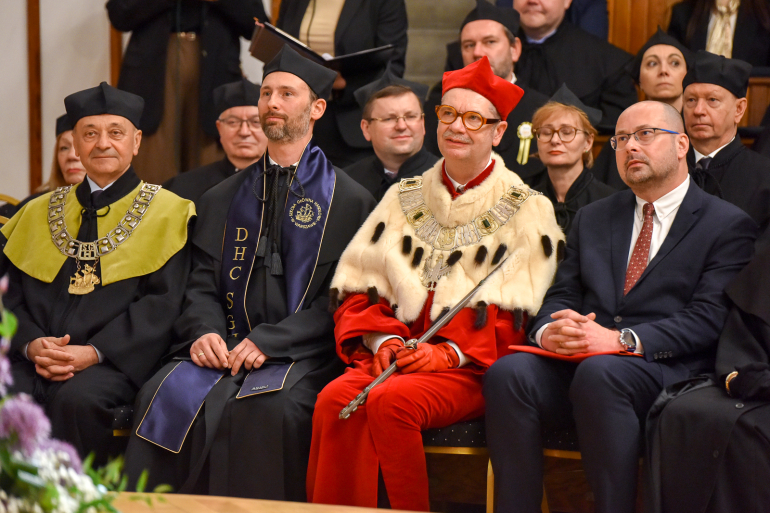
On 10 April 2026, the Rector and Professor of the SGH Warsaw School of Economics, Dr hab. Piotr Wachowiak, conferred the diploma of Doctor honoris causa upon the Polish astronaut Dr Eng. Sławosz Uznański-Wiśniewski in recognition of his outstanding contributions to the advancement of science and international cooperation. The ceremony of awarding the diploma certifying the conferment of the honorary degree forms part of the celebrations marking the 120th anniversary of SGH, held under the motto ‘Tradition that shapes Tomorrow’.
Dr Eng. Sławosz Uznański-Wiśniewski is, after Mirosław Hermaszewski, the second Pole in history to travel into space and the first citizen of Poland to have stayed aboard the International Space Station (ISS). He was selected from 22,500 candidates, including 549 from Poland. On board the Dragon Grace capsule, between 25 June and 15 July 2025, Dr Uznański-Wiśniewski participated in the Ax-4 mission as a member of a four-person crew, serving as a mission specialist alongside mission commander Peggy Whitson (USA), mission pilot Shubhanshu Shukla (India), and mechanical engineer Tibor Kapu (Hungary).
‘We are proud that Dr Eng. Sławosz Uznański-Wiśniewski has joined the SGH community. Among the honorary doctors of SGH – the highest distinction awarded by the SGH Warsaw School of Economics to scholars since 1968 – are primarily economists, but also social activists, economic practitioners, and distinguished figures of public life. Until now, this distinguished body has not included an astronaut. Above all, we recognised the Doctor’s academic achievements and his contributions to international cooperation. Dr Eng. Sławosz Uznański-Wiśniewski is also the youngest recipient of the SGH honorary doctorate. We are pleased that the conferment upon a Polish astronaut-scientist coincides with the 120th anniversary of SGH’, stated SGH Rector Piotr Wachowiak in a press release issued to the media.
‘It is a great honour for me to join the community of SGH honorary doctors. I regard this distinction not only as personal recognition, but above all as an expression of appreciation for the entire Polish scientific and engineering community, which contributes to the development of space technologies and their applications for the economy. We stand on the threshold of an era in which human presence in space will be as commonplace as global communication is today. What we do now – as scientists, engineers, and economists – will determine the future shape of our economy. I hope that Poland can be part of this transformation’, said Dr Eng. Sławosz Uznański-Wiśniewski in a press release.
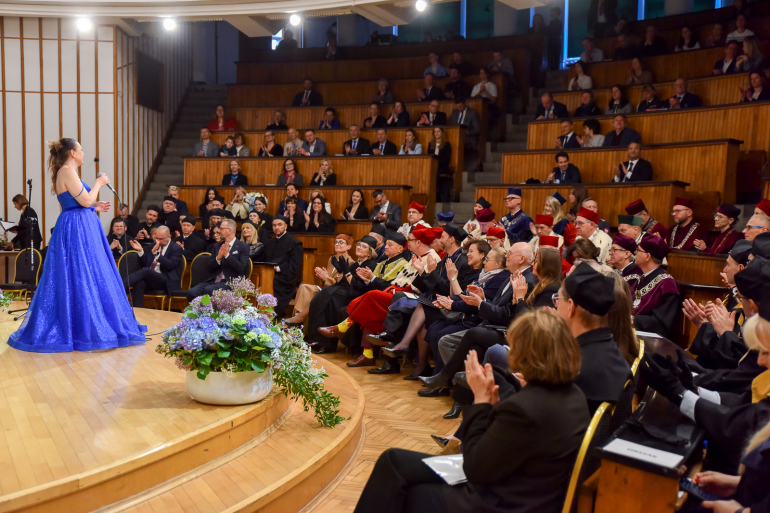
The ceremony was attended by representatives of national and local authorities, including the Deputy Marshal of the Senate of the Republic of Poland, Małgorzata Biejat, the Minister of Science and Higher Education, Marcin Kulasek, the Deputy Mayor of the Capital City of Warsaw, Renata Kaznowska, as well as Members of the Polish Parliament, the authorities of SGH and other Polish universities, former Rectors of SGH, and representatives of the diplomatic corps. The Main Hall was filled to capacity with distinguished guests and members of the community of the SGH Warsaw School of Economics.
Sławosz Uznański-Wiśniewski was accompanied by his family, including his wife Aleksandra and his parents, Maja and Piotr Uznański.
‘We had to wait for nearly half a century for another Pole to look at the Earth from orbit. Thanks to Dr Sławosz Uznański-Wiśniewski, those aspirations have become reality. Poland has returned to space in remarkable fashion. Today, one may confidently state that we are living in the era of Sławosz Uznański-Wiśniewski. This is a time in which we are no longer merely observers; we have become fully-fledged architects of the future’, said the Head of the Ministry of Science and Higher Education.
‘It was Polish technical thought and Polish research courage that extended the frontiers of knowledge aboard the International Space Station. These boundaries were advanced personally by the hero of today’s ceremony. The title of Doctor honoris causa is a tribute to the scientist and to his courage, but not only that. It is a symbol of our gratitude. Today, we all express our thanks for the IGNIS mission, for 20 days in orbit, and for 13 groundbreaking experiments. I would also like to offer my particular personal thanks for the 17 meetings (at Polish universities – editor’s note) held as part of the “Poland Reaches for the Stars” tour. It was an exceptional and intensive period that brought space closer to thousands of young Poles, opened minds, and filled them with dreams of the stars. Dreams that may indeed come true. I am grateful and proud that the Ministry of Science and Higher Education could be part of this. Today, we look with satisfaction upon the recognition of this tremendous work.
‘The title of Doctor honoris causa, conferred upon Dr Sławosz Uznański-Wiśniewski, carries particular significance; it is both a powerful expression of the emotions we feel and articulate when enumerating the achievements of our astronaut, and a spotlight illuminating these accomplishments with the brightest light. It is a light that has inspired many young minds to think: “I would like to achieve the same”. This is of great importance and constitutes a powerful force – such a positive impact on reality.
‘Doctor, thank you for this strength and for this courage. Your Magnificence, Honourable Senate, thank you for this decision. It stands as a ready source of inspiration for future generations of Polish researchers’.
Minister Kulasek then addressed the students: ‘Looking at today’s protagonist, remember one thing: limits exist only in our minds. If Dr Uznański-Wiśniewski was able to reach the stars, you too can achieve anything. Be ambitious, do not take shortcuts, and work diligently. The future is yours’.
A representative of the Sejm of the Republic of Poland read out a letter from Marshal Włodzimierz Czarzasty, in which he pointed out that ‘admission to the community of honorary doctors of the SGH Warsaw School of Economics has a symbolic dimension’. ‘The University, which for generations has been a cradle of modern socio-economic thought, today gains an exceptional ambassador. Your achievements demonstrate that modern science and technology are not only instruments of progress, but also a means of building international cooperation. The space mission in which you participated had both a scientific and a profoundly humanistic dimension. For many young people, you have become an authority for contemporary times, a model of courage, determination, and consistent effort in the pursuit of dreams’, wrote Marshal Czarzasty in his letter.
The laudation in honour of the SGH doctor honoris causa was delivered by the supervisor of the proceedings, Dr hab. Roman Sobiecki, Prof. SGH, who emphasised the historical significance of the Pole’s mission and the fact that it constitutes ‘an exceptionally important factor stimulating the development of the Polish space sector and the entire economy, as well as science’.
Professor Sobiecki recalled that during his nearly three-week stay in orbit, as part of the Polish IGNIS technological and scientific mission, Dr Eng. Sławosz Uznański-Wiśniewski conducted 13 experiments relating, inter alia, to medicine, biology, biotechnology, and engineering sciences. ‘At the same time, together with the international crew, he supervised the course of approximately 60 experiments. As emphasised by the Rector’s Plenipotentiary for Space Affairs at SGH, Professor Dr hab. Elżbieta Marciszewska, with the IGNIS mission that Dr Sławosz Uznański-Wiśniewski participated in, Poland is not only pursuing its national research objectives and ambitions, but is also actively contributing to the global development of innovative technologies. We can also speak of a spectacular success of Polish science, as, for the first time, scientific and implementation-oriented experiments developed and selected by Polish researchers were tested by a Polish astronaut-scientist aboard the International Space Station’.
The conferment of the honorary doctorate by the SGH Warsaw School of Economics, an economic university, upon an astronaut – as rightly observed on the one hand by the Honorary President of the Polish Economic Society, Professor Elżbieta Mączyńska, and on the other by Professor Marciszewska in their reviews – constitutes an expression of highlighting and recognising the multidimensional significance of the development of space research for economic innovation, the advancement of education, and social and environmental progress. ‘It fully aligns with the broad programme of the SGH policy pursued for over a dozen years in the field of developing economic education for the space sector. As an economic university, SGH recognises the considerable potential for the development of the space sector, as well as the challenges faced by the academic community in connection with the dynamics of this development, particularly in the areas of economic education, workforce preparation, and research for the space sector’, reads the laudation. ‘In order to support this development, the University has signed a cooperation agreement with the Polish Space Agency (POLSA), which serves the implementation of joint projects concerning the Polish space sector, including research and educational initiatives. SGH is also a member of the Academic Space Network established in 2021. (…) Cooperation within this network, together with the strengthening of relations with POLSA, as well as with the European Space Agency (ESA), are factors enabling SGH researchers – specialists, inter alia, in economics, finance, law, and project management – to be involved in the implementation and economic evaluation of projects concerning the development of the space sector’.
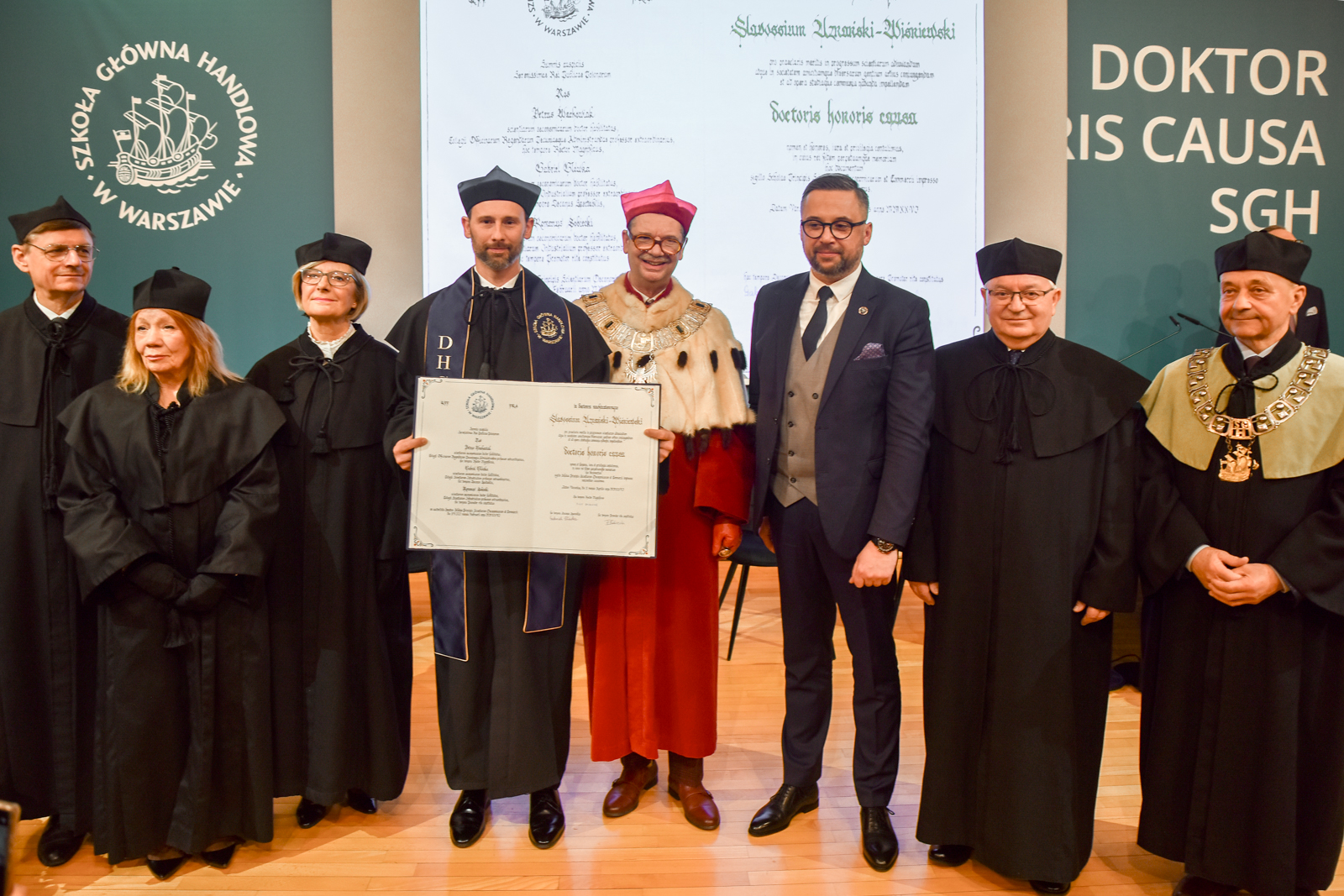
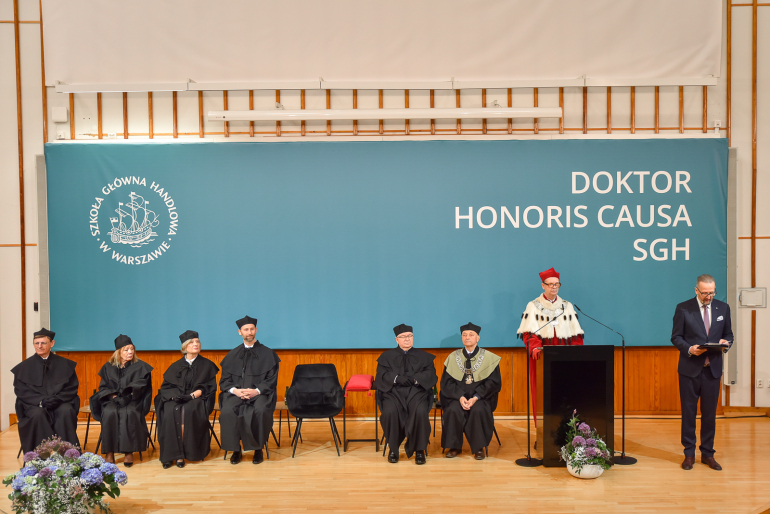
In the photograph, from the left: Professor Grzegorz Wrochna, Professor Elżbieta Mączyńska, Professor Elżbieta Marciszewska, Dr Eng. Sławosz Uznański-Wiśniewski, Rector Dr hab. Piotr Wachowiak, Minister Marcin Kulasek, Dr hab. Roman Sobiecki, and Dr hab. Gabriel Główka.
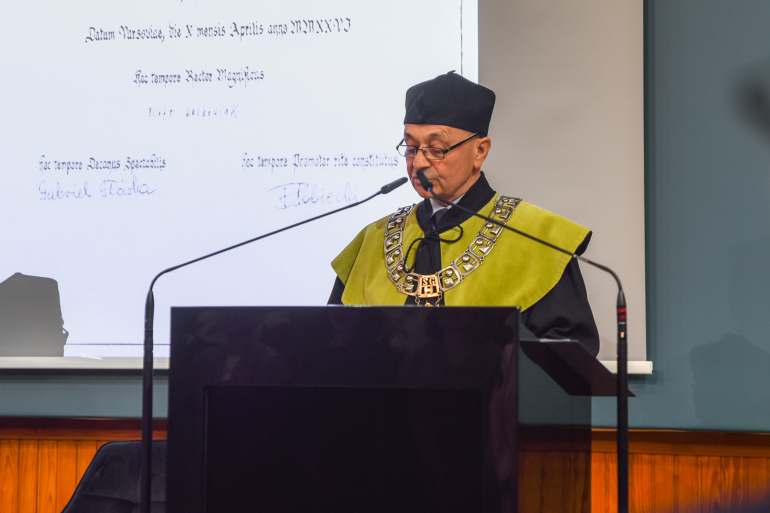
The Latin text of the diploma was read out by Dr hab. Gabriel Główka, Prof. SGH, Dean of the Collegium of Business Administration of SGH.
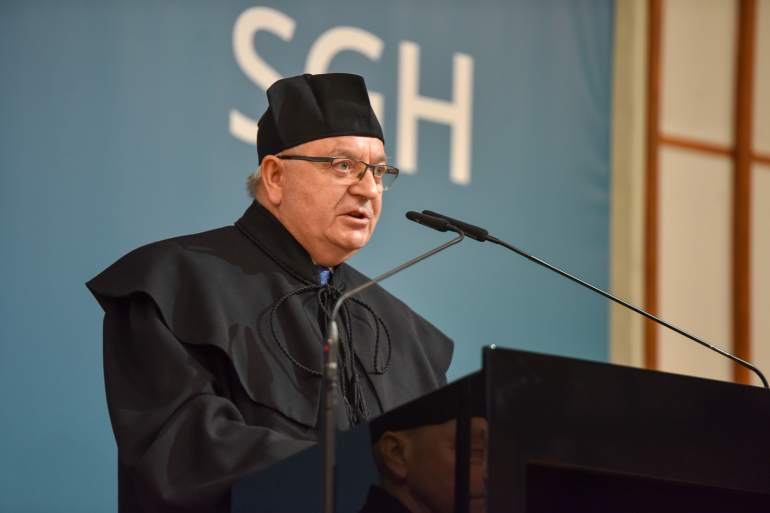
In his lecture, Dr Eng. Uznański-Wiśniewski observed that space is becoming a laboratory for the future of the knowledge-based economy. ‘In the 21st century, space has ceased to be merely a domain of scientific research and exploratory missions. It has become one of the key strategic areas of the contemporary world –a sphere in which technologies determining the functioning of modern societies are developed: from global communication and satellite navigation, through Earth observation, to the security of critical infrastructure and the development of new branches of the economy. Increasingly, space is also becoming a domain for building the technological sovereignty of states and regions’, indicated the SGH doctor honoris causa.
‘At the same time, we are observing a profound transformation of the global space ecosystem. Alongside traditional leaders – the United States and China – new technological powers, such as India and Japan, as well as Europe, which is strengthening its ambitions in terms of autonomous access to space, orbital infrastructure, and the exploration of more distant regions of the Solar System, are playing an increasingly significant role. In parallel, funding for space and dual-use technologies, combining civilian development with the security needs of states, is on the rise.
In this dynamically evolving environment, the participation of countries such as Poland is of particular importance. States with strong scientific potential, a developing engineering base, and a growing sector of innovative enterprises can play a significant role in building an open and interconnected European space ecosystem, capable of competing globally while simultaneously remaining a space for cooperation between science, industry, and public institutions’, stated Dr Eng. Uznański-Wiśniewski in his lecture.
He further emphasised that the first Polish mission to the International Space Station, named IGNIS, forms part of this process as an event whose significance extends far beyond the spaceflight itself. It has become a catalyst for discussion and action centred around five pillars of the development of the space sector in Poland and Europe:
1. The impact of the mission on science and education, and on building the workforce of the future. According to Dr Uznański-Wiśniewski, ‘space exploration is not solely a scientific endeavour; it is a social and educational project that shapes future generations of scientists, engineers, and innovators’.
2. The development of the Polish technological ecosystem. Dr Uznański-Wiśniewski emphasised that the presence of an ESA Centre in Poland may serve as a catalyst for the emergence of a new technological ecosystem: national, regional, and European.
3. The development of mechanisms for financing innovation. As indicated by the Polish astronaut, the advancement of the space sector requires a coherent system of financing, ranging from basic research to commercialisation and scaling on international markets.
4. The significance of space technologies for state policy. According to the scientist, in the 21st century, access to outer space is becoming for states what access to energy and the Internet was in the 20th century.
5. The future of European space exploration. In this context, Dr Uznański-Wiśniewski pointed out that the United States is currently implementing the largest technological programme since the Apollo missions. And he posed the question of whether we envisage Europe and Poland as partners in this programme.
‘The IGNIS mission is not merely a symbol – it is a stimulus mobilising society, science, industry, and public institutions towards joint action’, he emphasised.
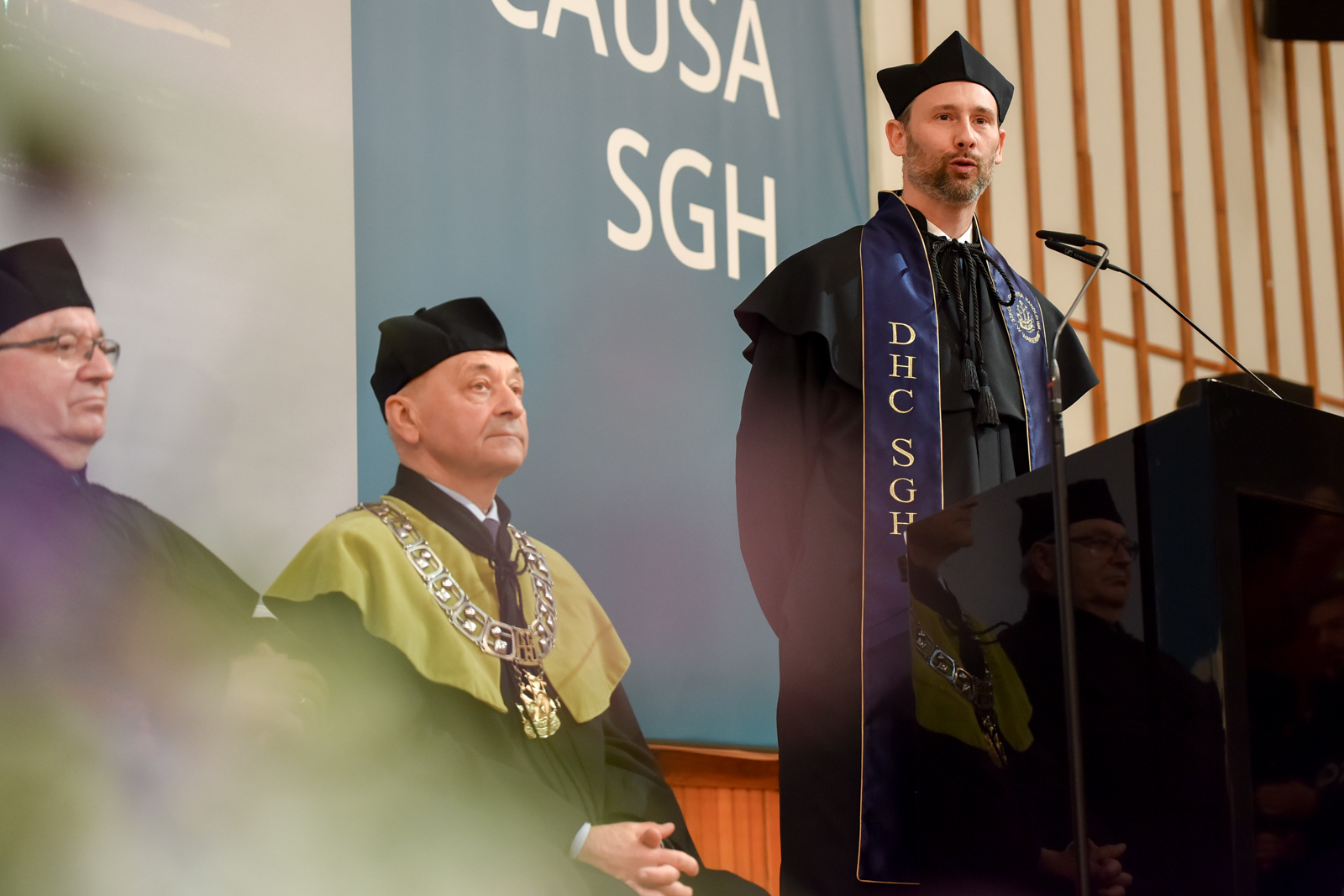
The full lecture of the SGH doctor honoris causa will be published in the spring issue of Gazeta SGH.
The resolution on conferring the title of doctor honoris causa of SGH upon Dr Eng. Sławosz Uznański-Wiśniewski was adopted on 18 February of the current year by the SGH Senate and entered into force on the same day. The procedure for awarding this title was initiated by the SGH Senate on 15 October 2025 at its first meeting in the new academic year 2025/2026. The motion was submitted by Dr hab. Roman Sobiecki, Prof. SGH, Dr hab. Beata Czarnacka-Chrobot, Prof. SGH, and Dr hab. Joanna Wielgórska-Leszczyńska, Prof. SGH.
Pursuant to the resolution adopted by the SGH Senate to initiate the procedure, Dr hab. R. Sobiecki was appointed as the supervisor, and Professor Elżbieta Marciszewska, Professor Elżbieta Mączyńska, and Professor Grzegorz Wrochna were designated as the reviewers.
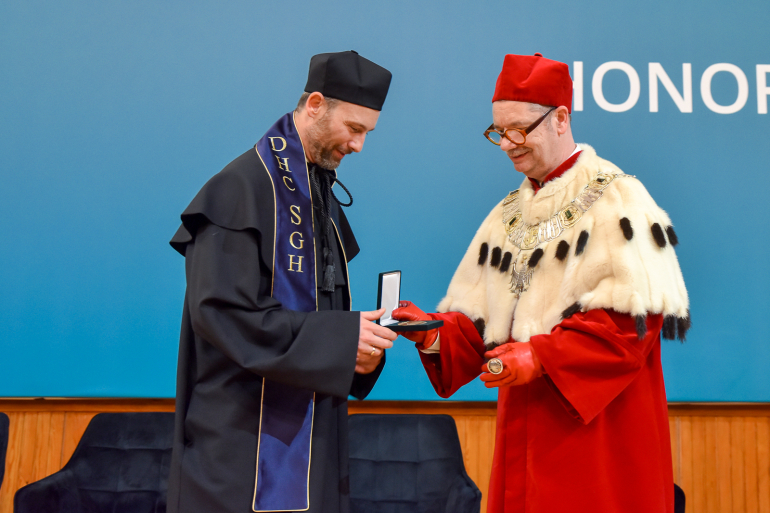
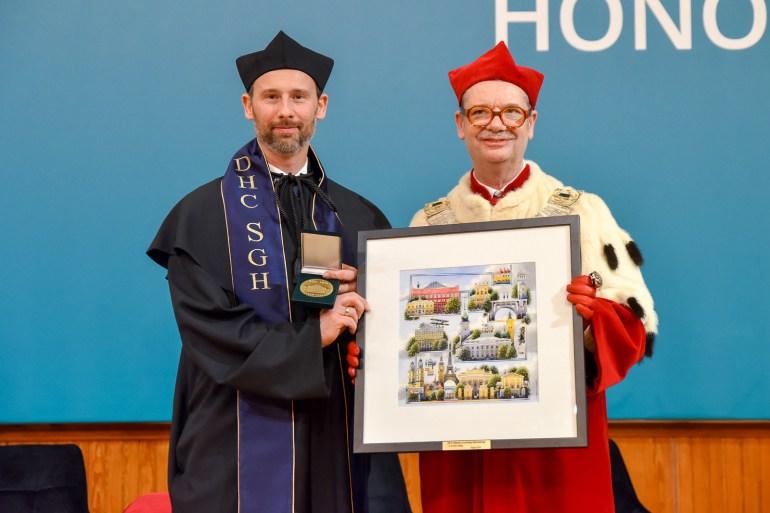
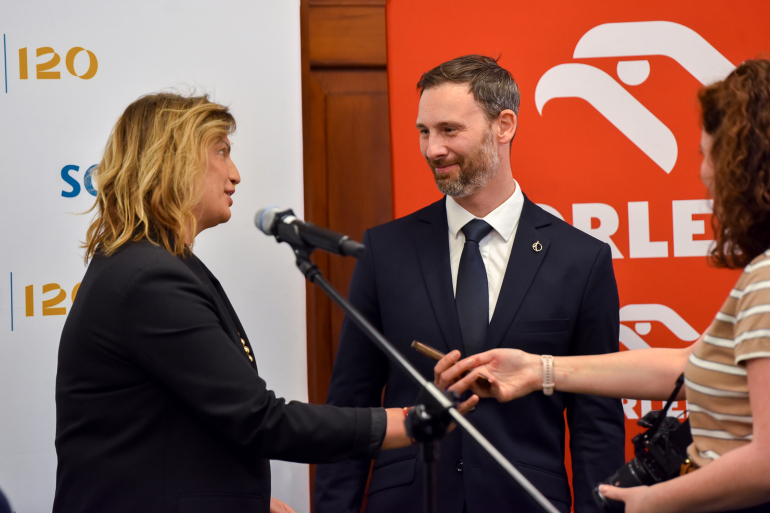
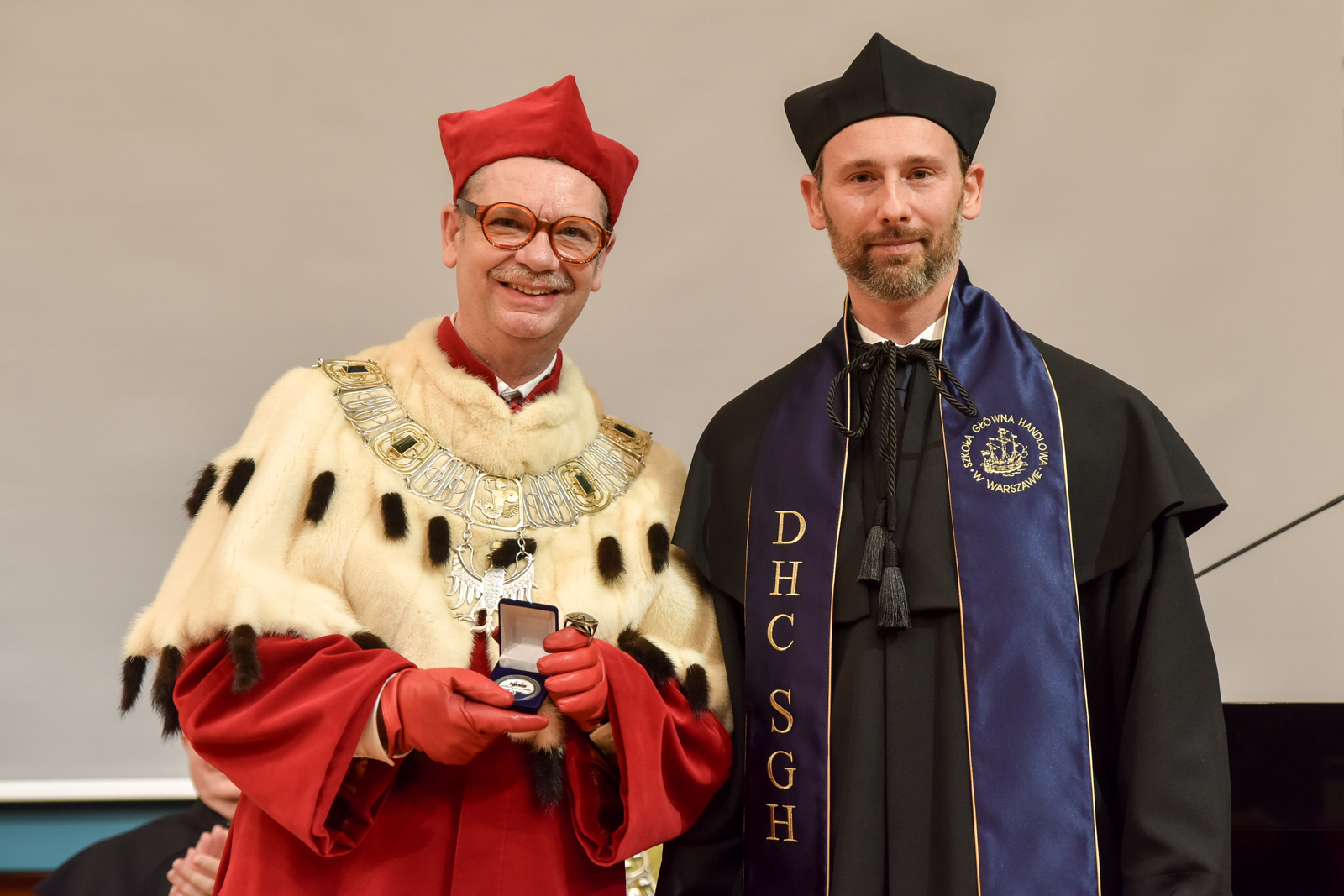
At the conclusion of the ceremony, Rector Piotr Wachowiak presented the SGH doctor honoris causa, Dr Eng. Sławosz Uznański-Wiśniewski, with the Medal of the 120th Anniversary of SGH, minted specifically for this jubilee. On the occasion of Dr Uznański-Wiśniewski’s birthday, which falls on 12 April, he also presented a reproduction of the mural design ‘The President from SGH’ by Tytus Brzozowski, an architect and painter associated with Warsaw. In 2022, SGH celebrated a special anniversary: the centenary of Stanisław Wojciechowski, a professor associated with the University in the years 1919–1939, assuming the office of President of the Republic of Poland.
Immediately after the conclusion of the SGH doctor honoris causa lecture, Sławosz Uznański-Wiśniewski presented the IGNIS mission medal to the Rector of SGH.
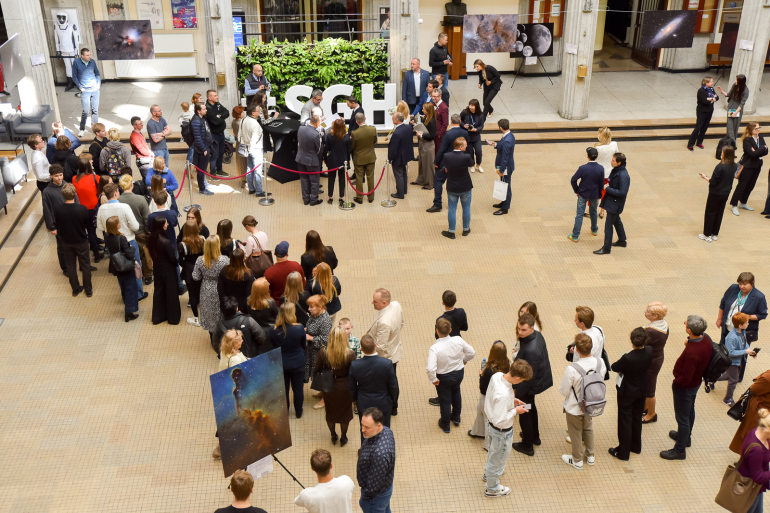
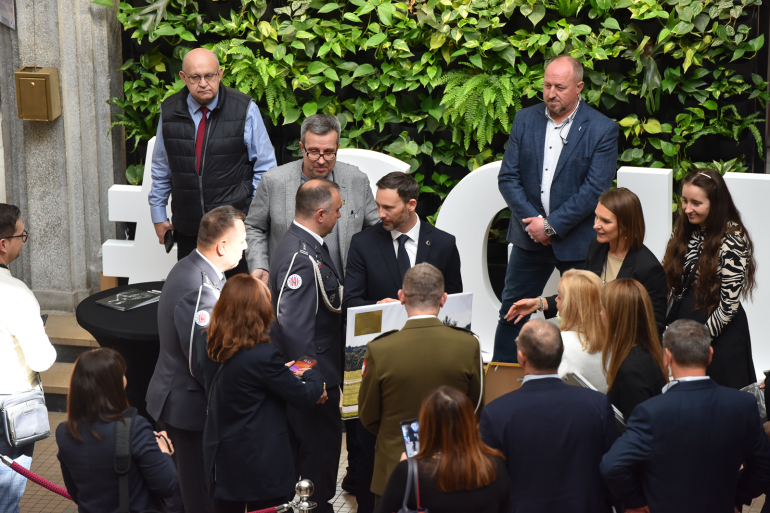
Following the formal conclusion of the ceremony, invited guests were able to view the astrophotography exhibition ‘Whisper of the Stars’ by Paweł Radomski in the Parachute Hall, as well as queue for an autograph from the Polish astronaut.
The events of the jubilee year at SGH combine a variety of activities and initiatives that strengthen the SGH community, its affiliates and supporters, and incorporate commemorative symbolism. From the inauguration on 8 October 2026, throughout the entire academic year 2025/2026, until the conclusion of the celebrations in December 2026, the University campus hosts a wide range of official ceremonies, academic, student, cultural, sporting, and partnership events, highlighting that SGH is a modern and dynamically developing university, open to the challenges of the contemporary world.
The Marshal of the Senate of the Republic of Poland, Małgorzata Kidawa-Błońska, assumed honorary patronage over the 120th anniversary celebrations of SGH. The patron of the SGH anniversary is Orlen S.A., while the strategic partners are PZU S.A. and Santander Bank. Media patronage of the jubilee events has been assumed by the Polish Press Agency, the daily ‘Rzeczpospolita’, ‘Dziennik Gazeta Prawna’, ‘Puls Biznesu’, money.pl, TVP3, and Radio Kampus.
PHOTO: Piotr Potapowicz, SGH