Pro-Palestinian Activism as an Intersectional Movement – summary report of the panel
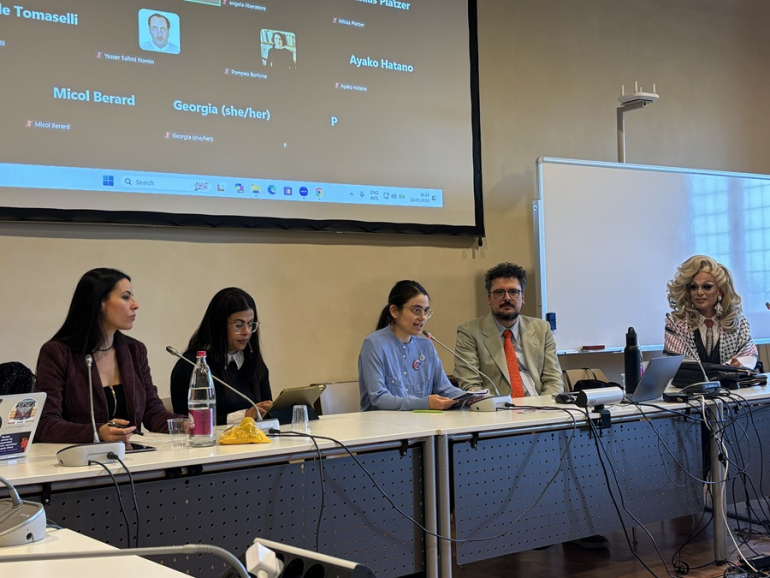
On March 24th 2026, at the European University Institute (EUI), in the historic setting of Villa Salviati, took place the panel “Pro-Palestinian Activism as an Intersectional Movement”. The event was organised in coordination with The Queer and Feminist Studies Working Group and the Working Group on Palestine of the EUI and with the support of Professor Bruno Gammerl and Professor Monika Baar. The panel aimed to shed light on a relatively overlooked phenomenon that constitutes an attempt to deconstruct the dominant narratives on the Palestinian Israeli conflict.
The event included contributions from both academics and activists in order to provide a well-rounded overview of the issue and, ideally, to bridge theoretical analysis with the insights of those actively involved in shaping social movements around these questions. The panel was chaired by Daniela Chironi from Scuola Normale Superiore, who also delivered the concluding remarks.
The first part of the panel featured contributions from four academic panellists: Ghadir M.A. Abumiddain (Scuola Normale Superiore), Federica Stagni (Scuola Normale Superiore), Karolina Rak (Jagiellonian University in Krakow), and Fabio Coriolano ( SGH Warsaw School of Economics).
Ghadir M.A. Abumiddain focused on the history of the Palestinian feminist movement, highlighting how Western feminism often displays epistemological limitations when expressing solidarity with Palestinian women. While segments of Western feminism frame the issue in isolation from its context, they overlook the specific settler-colonial conditions shaping the struggle for women's liberation in Palestine. For Palestinian women, the struggle for national liberation goes hand in hand with the achievement of gender justice, as women's lives and bodies are primary targets of the conflict. The specificity of the colonial system operating in Palestine has produced a fragmented feminist movement. Nonetheless, Palestinian feminism has also created moments of grassroots unity, as demonstrated by the Tala'at movement in 2019.
The second contribution was delivered by Federica Stagni, who analysed the experience of the feminist movement "Non Una di Meno" (NUDM) in expressing support for Palestine. The organisation's attempt to create a connection between the Palestinian liberation movement and feminism by adopting an intersectional approach attracted criticism from both outside and within the movement itself. More liberal voices argued that a feminist movement should express a strong condemnation of Hamas, while those closer to the Palestinian movements maintained that Western liberal perspectives must be deconstructed in order to be applied to the Palestinian context.
The third presentation came from Karolina Rak, who analysed from a Polish perspective the wave of pro-Palestinian activism during the recent conflict in Gaza. Dr. Rak highlighted the different socio-cultural narratives used to frame the movement and the clash between attempts to suppress the public expression of support for Palestine in Polish universities and the counterstrategies adopted by students. While the dominant narratives relied on the shared memory of the Holocaust to label the protests as "antisemitic," the activists focused on the distinction between antisemitism and anti-Zionism, drawing on non-Zionist Jewish narratives (e.g., "Doikayt").
The following speaker, Fabio Coriolano, addressed LGBTQIA+ activism in favour of Palestine, framing it as a counter-narrative challenging the dominant discourse on Israel as the sole safe space for LGBTQIA+ individuals in the region. While the prevailing discourse presented queer activism in favour of Palestine as a contradiction—arguing that activists would support political movements like Hamas that are openly homophobic—the analysis identified four distinct counter-narratives used to frame intersectional solidarity between LGBTQIA+ communities in Europe and the Palestinian cause. More specifically, these narratives developed around the ideas of stopping the ongoing genocide, adopting intersectional approaches, denouncing colonialist practices, and identifying solidarity with other oppressed groups as a core component of queer identity.
The second part of the panel featured contributions from activists: the drag queen Priscilla (a.k.a. Mariano Gallo), Chiara Isabelle Berard, and Davide Curcuruto.
Priscilla's intervention drew a connection between her personal experience and the struggle for liberation of the Palestinian people. She described herself as a young boy who had experienced discrimination for not conforming to social expectations, and how drag art allowed her to claim the space to express her personality. During this process, Priscilla realised the similar patterns of discrimination that oppress different communities and understood how a drag queen has the position and the strength to challenge the dominant narrative and remind us that the freedom to exist should be granted to everybody. As Priscilla said in her speech:
“When queer and transfeminist movements stand with Palestine, they are not saying that all experiences are the same. They are saying something much simpler. That freedom cannot be selective.
Because selective freedom is not freedom. It is privilege. And privilege, by definition, always rests on the exclusion of someone else.”
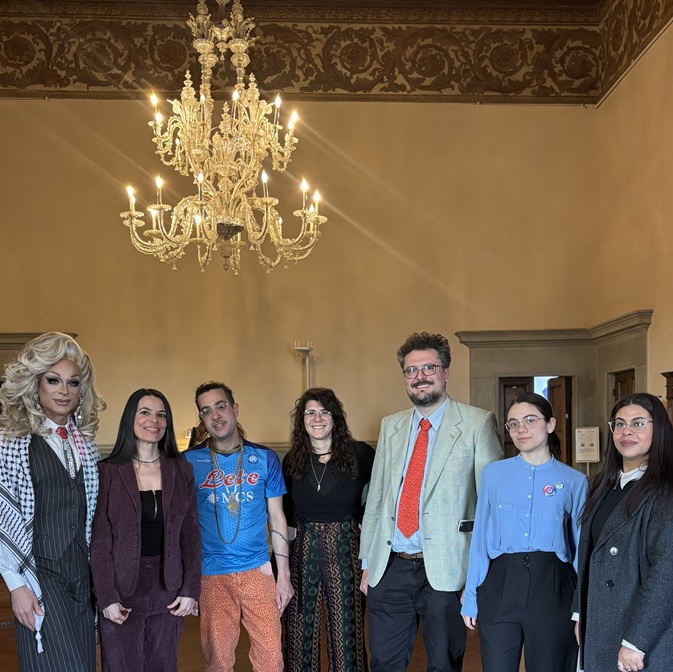
Chiara Isabelle Berard reflected on her experience as an activist in Aosta and Turin, exploring the practical challenges of building intersectional coalitions across queer, feminist, and pro-Palestinian movements. She has organised and participated in demonstrations contesting dominant narratives and denouncing pinkwashing practices—for instance, the protests against Israel's participation in the 2022 Eurovision Song Contest in Turin. She noted that her positions have drawn criticism not only from liberal and pro-Israeli segments of public opinion, but also from within the queer community itself.
Finally, Davide Curcuruto described the experience of Arrevutamm Pride in Naples as an attempt to create a more democratic and grassroots organisation in opposition to the more institutional pride march organised by the local Arcigay Naples. Davide explained that the decision to organise an alternative event stemmed from several concerns: Arcigay Naples' position on the war in Gaza, considered too supportive of Israel; the presence of commercial sponsors; and a lack of transparency in the organisational process. The experience allowed the activists to reflect on their position as an LGBTQIA+ community in a Western but peripheral city, and on how a queer struggle that is also an economic and class struggle could materially express solidarity with Palestine. The split from the official Pride march provided grassroots organisations with the opportunity to create a new, more open, and still evolving platform to redefine the political perspectives of queer activism.
The chair and discussant Daniela Chironi delivered the concluding remarks, noting that while the event had laid the groundwork for the future, a concrete intersectional approach has not yet been fully achieved. She then traced a fil rouge of themes that characterised the panel.
First, intersectionality emerged as a goal to aspire to—a lens allowing us to read together forms of oppression that appear different but are products of the same system. Second, decolonisation appeared as a necessary direction of analysis. Third, panellists emphasised the need to develop counter-narratives to deconstruct oppressive dominant discourses. While much of this effort still takes place within academic bubbles, it is important to acknowledge attempts to "breach into reality." Fourth, solidarity emerged as a recurring theme—understood as mutual recognition among oppressed groups and acknowledgement of being victims of the same system of oppression. Fifth, the agency of Palestinians and the groups that support them was highlighted: Palestinians must not be described merely as victims, but rather through a lens that acknowledges the history of resilience and resistance of Palestinian communities. Finally, the contributions revealed that there exists not only a hierarchy of lives but also a hierarchy of movements: feminists and LGBTQIA+ activists are often required to justify their ideas, their positions, and their voices.
Daniela Chironi concluded with the hope that existing hierarchies will be overturned and that a new world will be possible.
The panel's significance lies in its ability to combine academic rigour with activist insight, creating a space where theoretical frameworks and lived experience could inform one another. This dialogue between scholars and activists highlighted the relevance of an intersectional approach to understanding social movements in support of Palestine. Rather than accepting dominant narratives at face value, the event offered tools to deconstruct them—revealing the connections between struggles for Palestinian liberation, gender justice, and LGBTQIA+ rights. In doing so, it pointed toward new possibilities for solidarity and collective action.
Fabio Coriolano, SGH Warsaw School of Economics
The trip was funded by the Minister for Science under the Regional Excellence Initiative Programme.