As part of the CIVICA Faculty Visit Programme, I had the pleasure of visiting the House of Innovation at the Stockholm School of Economics (SSE) - one of Europe's leading business schools, and an institution whose reputation for combining rigorous academic research with a strong orientation toward real-world economic challenges precedes it.
The House of Innovation itself is a particularly dynamic environment: it brings together economists, management scholars, and technology researchers under one roof, creating a genuinely interdisciplinary space where questions about digitalization, innovation, and the future of business are approached from multiple angles at once. Given the department's strong focus on FinTech, digital transformation, and technology-driven business models, I see clear potential for SGH researchers working on digital trust, cybersecurity, and consumer behavior in financial services to find natural partners for collaboration at SSE.
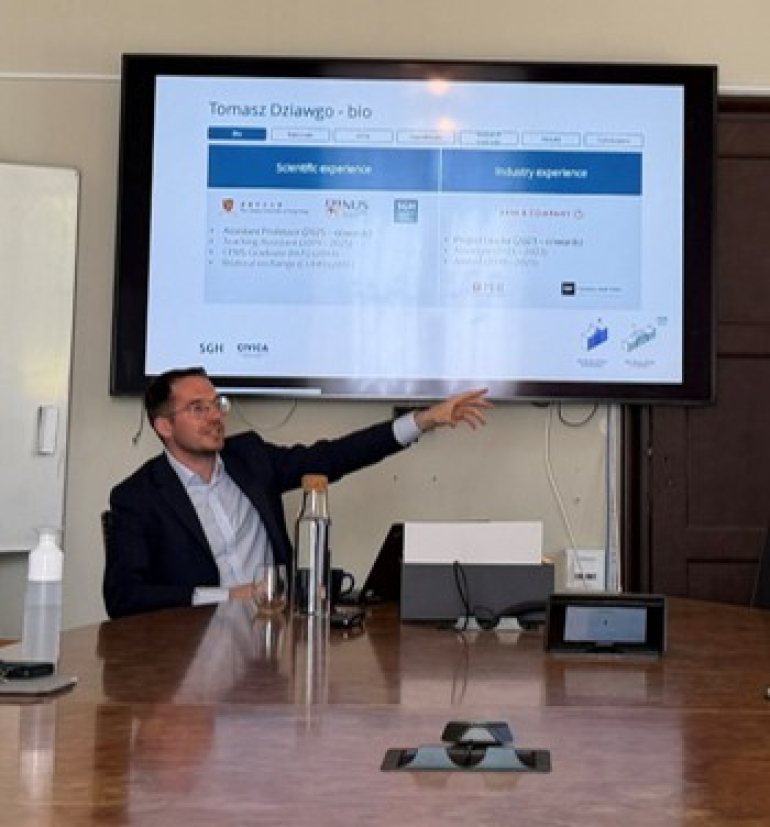
Before departing, I prepared a full presentation of my research findings to share with the host department - a decision that, in hindsight, shaped the entire visit for the better. Rather than a general introductory meeting, the visit immediately turned into an academic discussion, with researchers responding directly to specific results and methodological choices.
If I had to give one piece of advice to someone planning a similar trip, it would be as follows: arrive with a concrete piece of research ready to present. A visit without a clear scientific anchor can easily drift into pleasant but inconclusive small talk; a visit built around an actual presentation almost automatically produces meaningful feedback, sparks genuine interest from the host institution, and - perhaps most importantly - reveals where your research interests and theirs overlap. This above-mentioned overlap is exactly where future collaboration tends to begin.
If I were to single out the greatest value of the trip, it would be twofold. Scientifically, presenting my research to an international, highly engaged audience - and receiving direct, often unexpected feedback - pushed me to think about my findings from angles I hadn't fully considered before, particularly regarding their practical implications for financial institutions. Personally, the visit allowed me to build a genuine, direct connection with the House of Innovation team: the kind of relationship that doesn't end when the visit does but instead becomes a starting point for further exchange - whether through joint publications or future visits.
My research examines how regulatory awareness and exposure to protective technologies shape the way banking customers think about cybersecurity - specifically, how these factors influence trust, perceived control, and security-related behavior in retail banking. The study produced several notable findings: customers who are aware of regulations such as GDPR report both higher trust in financial institutions and a greater sense of control over their own data; clients who have personally experienced a cybersecurity incident become noticeably more skeptical toward new digital features; and, encouragingly, greater awareness of protective technologies is associated with more secure user behavior overall.
Taking together, these results speak to the question that financial institutions across Europe are currently grappling with building technically secure systems is necessary, but it is not sufficient on their own. The deeper, more elusive challenge is building digital trust - and that requires institutions to think not only about technology, but about regulation, communication, and customer psychology in tandem. Presenting these findings at the House of Innovation sparked a lively discussion precisely along these lines, with researchers drawing comparisons to the Swedish banking context and raising questions about how these dynamics might play out differently across national regulatory environments.
Beyond the research exchange itself, the visit also opened the door to longer-term cooperation. A natural thematic anchor for such collaboration would be digital trust, cybersecurity, and regulation in financial services - a topic that clearly resonates with both institutions, and one that would give students from both schools the chance to engage directly with current, applied research questions shaping the future of FinTech.
Altogether, the visit to the House of Innovation was a reminder of how valuable these short, focused research exchanges can be - not only as an opportunity to present one's own work, but as a genuine catalyst for new ideas, new questions, and new partnerships. I'm grateful to the SSE team for the warm welcome and the stimulating discussion, and I look forward to seeing where this connection leads - be it through joint publications or future visits.
dr Tomasz Dziawgo, Assistant Professor, Department of Banking Safety Net, Institute of Banking, Collegium of Socio-Economics at the SGH Warsaw School of Economics