HUMANE at SGH: How Can Universities Support Students Throughout Their University Journey?
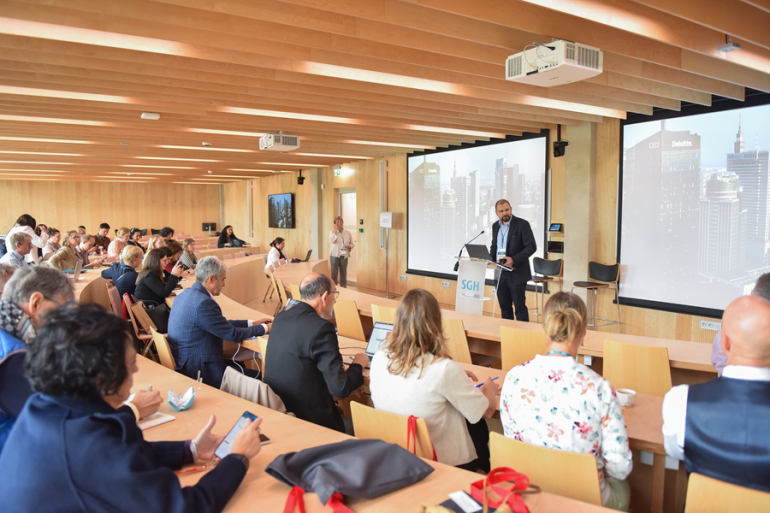
On 8–9 October 2026, SGH Warsaw School of Economics hosted the HUMANE seminar “Harnessing the student journey: strategies to maximise student success”. Discussions centred on how universities can support students’ development and wellbeing, help prevent dropout and prepare students for life beyond university.
The seminar was the first HUMANE event to be held in Poland and coincided with SGH’s 120th anniversary. The network brings together nearly 200 European universities, represented by leaders of university professional services. Rather than looking for ready-made solutions, participants explored questions universities are grappling with today. How can we spot it when a student is struggling before they decide to leave? How can support be available to everyone while still responding to individual needs? And how can universities give students a meaningful voice in university life without leaving them to carry the responsibility alone?
At SGH, we invest in student organisations, where young people gain experience of leading projects and teams, take responsibility for shared initiatives and learn to work with others. This is what we mean when we say that “SGH shapes leaders”. The seminar invited us to view this idea more broadly: students need room to take initiative, as well as resources, trust and clear ground rules, if they are to thrive.
The first question was what we mean by student success. Is it enough to measure attainment, completion and employment? Geoff Green of the University of Leicester argued for a broader view, spanning admission and the first days at university, progression and completion, and the transition into employment or further study. This kind of strategy requires universities to know their students, listen to student voices, focus on outcomes, and deploy resources with agility. It cannot be left to a single office. Student success must be considered in the everyday decisions made across the institution.
How can universities support wellbeing when students have different needs and access to specialist care is limited? Mike Nachtegael of Ghent University presented a step-care approach. Its foundations are a well-being-promoting learning and living environment, a sense of belonging and prevention. The next levels involve early detection, low-threshold support and, where necessary, specialist care. Staff who are in day-to-day contact with students play an important role. They do not need to solve every problem, but they should feel able to start a conversation and guide a student towards the right support.
This led to another challenge: how can we recognise when a student is beginning to disengage from the university? A panel featuring Ed Foster of Nottingham Trent University and Beata Mierzejewska of SGH explored early warning approaches and the role of data. Experience from the Stay@SGH programme shows that dropout is rarely the result of a single event. Academic difficulties may be compounded by uncertainty about procedures, loneliness, personal problems and waning motivation. Data can reveal changes in behaviour or academic progress, but it cannot tell us what lies behind them. A flag generated by a predictive model should therefore prompt the university to look more closely at the student’s circumstances and offer support. It cannot replace conversation or human judgement.
Just as important is the question of where higher education should lead. Roberto Nocentini of the European University Institute spoke about preparing for PhD researchers for the labour market. This is not a conversation that should be put off until the final year. PhD researchers build professional capabilities throughout their doctoral journey: through teaching, mobility, mentoring, contact with alumni, teamwork and presenting their research to different audiences. The role of professional services is to bring these opportunities together into a coherent development pathway and to recognise careers beyond academia as equally valid choices.
The employer perspective came from Magda Grunwald-Sikora, Deputy Director of the SGH Centre for Corporate Relations. Companies want to see students in action, working on business projects and taking part in classes delivered jointly with employers. Career preparation cannot therefore stop providing information about the labour market. Students need opportunities to put their knowledge into practice, test themselves in collaborative settings and take responsibility for real tasks.
How can universities give students an international experience when a full semester abroad is not an option? Karen Triquet of Vrije Universiteit Brussel presented the educational model developed by the EUTOPIA European University Alliance, which is built around cross-campus Connected Communities. Students co-create projects, conferences and assignments involving several universities, combining short-term mobility with hybrid and online formats. This approach to “Equity of Success” is about removing barriers to participation rather than offering everyone the same experience. Bringing such initiatives into the mainstream of university activity requires clear processes for recognising learning, effective tools, funding, and local administrative support.
The theme of belonging returned in a panel on student-led extra-curricular initiatives. Małgorzata Głogowska, Head of Student Support at SGH, showed how, within a flexible system of study, smaller communities help students form lasting relationships and find their place at the university. Support for student organisations, training for student leaders, partnership with the Students’ Union and the Participatory Budget for Students and Doctoral Students are about far more than organising events. They give students a sense of agency and share responsibility for the university community.
Sandro Günther, Head of Community Life at Frankfurt School of Finance & Management, asked how universities can support dozens of initiatives through transparent rules that will keep working as the number of projects grows. He presented a system that shifts from reactive funding decisions to strategic investment in student-led activities. Baseline support allows every initiative to operate, while additional funding is linked to purpose, scale, impact and accountability. Students retain ownership of their ideas; professional services enable them through funding, governance and advice; and the institution sets its strategic priorities and level of investment. This division of roles enables universities to support student initiatives without taking them over.
Pierre Degott of Université de Lorraine broadened the discussion by considering students’ formal role in university governance. The University Life Council covers culture, sport, health, social support, disability and student initiatives. Students work alongside staff and external partners, and their contribution may be recognised as part of their studies. The French example showed that giving students a role in shaping university life requires resources, sustained representation and recognition of their contribution.
To close the seminar, Geoff Aldridge, Director of AI Office at The Open University, returned to a question that had run throughout the event: does technology genuinely help students, or does it simply make the institution more efficient? The solutions presented can help identify risk, analyse conversations with students and draft responses based on trusted sources. The starting point, however, must remain the benefit to the student, while assessment and decision-making must remain human responsibility. The most significant challenges concern data quality, clear ownership, alignment with everyday working practices, transparency and trust.
The Warsaw seminar did not produce a single formula for student success. It did, however, leave participants with questions worth returning to. Do we understand how students experience university life, or do we know only their results? Does support arrive early enough, and is it clear where students can find it? Do students have a genuine role in decision-making? And do new tools address the problems they face? Several priorities recurred across the discussions: intervening earlier, combining data with human judgement, making support easier to access and treating students as partners.
For us as hosts, the opportunity to learn from other universities and share SGH’s own experience was particularly valuable. The programme also made space to discover Warsaw and continue conversations beyond the seminar room. Before the seminar, we invited guests to join us for a walk through the city, while the first day ended with a dinner attended by Ewa Malinowska-Grupińska, Chair of the Council of the Capital City of Warsaw. After the sessions, participants were also invited to visit an exhibition of paintings by Malina Wieczorek at SGH. On social media, guests praised SGH’s hospitality, the seminar programme and the opportunity to exchange experiences. Many were visiting Warsaw for the first time and shared very positive impressions of their stay.
Marcin Dąbrowski, PhD, SGH Chancellor
Beata Mierzejewska, SGH Deputy Chancellor