
SGH Warsaw School of Economics at the World Economic Forum in Davos 2026
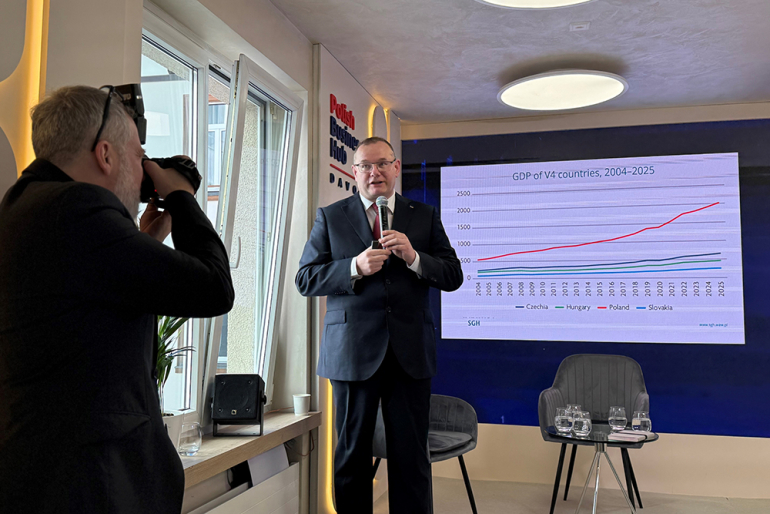
On 20–23 January 2026, Professor Arkadiusz Kowalski and SGH spokesperson Mariusz Sielski represented the SGH Warsaw School of Economics at the World Economic Forum in Davos. Their presence translated into active participation in the programme of economic and political debates accompanying the Forum and into bringing SGH’s perspective into discussions held in an international setting with representatives of politics, business and public institutions.
2026 is the first year in which SGH Warsaw School of Economics took part in the World Economic Forum in Davos. This is significant, as Davos is a place where, alongside leaders from politics and business, the academic community is also clearly present. The annual meetings are attended by representatives of leading universities, particularly from the United States. At the same time, European universities are visibly active, and the representation of Asian institutions is growing, as they consistently strengthen their international visibility.
One of SGH’s most important contributions to the World Economic Forum in Davos was the presentation of the monograph “Investment Competitiveness of Poland: Attractiveness, FDI and Global Value Chains”, edited by Professor Kowalski and prepared by the author team comprising Professor Kowalski, Professor Andżelika Kuźnar, Professor Eliza Przeździecka, Professor Małgorzata Stefania Lewandowska, dr Anna Dzienis, dr Artur Tomeczek and dr Tomasz Napiórkowski. The purpose of the monograph is to explain Poland’s investment competitiveness in relation to its overall international competitiveness and its changing role in the global production network.
Professor Kowalski also took part in Davos in the debate entitled “Amid a Revolutionary Transformation: Science as Growth Infrastructure”. The discussion included dr Wojciech Karczewski, Director of the Polish National Agency for Academic Exchange (NAWA); Magdalena Kołodziejska, Deputy Director of the National Centre for Research and Development; Beata Jaczewska, Director of the Department of Economic Cooperation at the Ministry of Foreign Affairs; and Professor Marek Kowalkiewicz (Queensland University of Technology, Australia), a recognised expert on artificial intelligence. In his remarks, the SGH representative stressed the need to treat science consistently as an investment in the long-term competitiveness of the economy. He underlined that achieving durable development effects depends on the efficiency of the entire system, from funding stability, through effective management of research programmes, to cooperation mechanisms between universities, business and public administration. In this approach, science contributes to competitiveness not only by generating knowledge, but also through the capacity to translate it into innovation, productivity and economic resilience. Referring to the development of research infrastructures supported financially by the European Union, Professor Kowalski also presented SGH’s achievements in this area. One example is SHARE (Survey of Health, Ageing and Retirement in Europe) – the first research infrastructure in the social sciences to obtain ERIC (European Research Infrastructure Consortium) status.
The presentation of one of SGH’s key contributions to Davos 2026, the monograph on “Investment Competitiveness of Poland: Attractiveness, FDI and Global Value Chains”, was made possible thanks to a partnership agreement with the hosts of the Polish Business Hub, with the support of NAWA. Presenting the monograph in Davos also had an institutional dimension, as it enabled SGH to be showcased as an analytical centre capable of combining an academic perspective with the needs of decision-makers and economic practice. In the WEF environment, where discussions are particularly intense on the reconfiguration of global value chains, economic security, and the costs of the energy and digital transition, the publication’s findings provided a reference point for conversations on the conditions for investment location in Central Europe.
The purpose of the monograph “Investment Competitiveness of Poland: Attractiveness, FDI and Global Value Chains” is to explain Poland’s investment competitiveness in relation to its overall international competitiveness and its changing role in global production networks. The book’s starting point is that the logic of competing for capital is evolving. Poland’s earlier success relied significantly on a predominantly cost-based model, supported by market access, improving infrastructure and integration into European production networks. In today’s environment, however, global competition for investment is increasingly shaped by resilience, predictability and the capacity to accommodate knowledge-intensive, intangible-rich and data-driven activities embedded in resilient local ecosystems. Consequently, the focus shifts from generic cost advantages to a more capability-based development model, in which location attractiveness depends more on institutional performance, energy and network readiness, the quality of human capital and the depth of innovation and supplier ecosystems.
Against this background, the monograph introduces investment competitiveness not as a narrow struggle over costs, but as a country’s ability not only to attract capital but also to embed it productively, diffuse technology and skills and upgrade its role in international production networks. At the same time, the authors stress that these gains are not automatic. If FDI is concentrated in routine, low-skill tasks with few linkages to local suppliers and innovation systems, it may lead to “thin industrialisation” and enclave-type production, with limited spillovers and high dependence on footloose activities, especially where absorptive capacity is weak.
Empirically, the volume confirms the scale and persistence of foreign direct investment in Poland and its contribution to economic development and integration into the world economy. Yet the authors argue that the current FDI-led growth model is becoming increasingly exhausted. As catching-up challenges intensify, Poland needs to transition out from an approach relying predominantly on cost advantages and scale towards one based more on capabilities, innovation, resilience and strategic selectivity. This diagnosis is closely connected to the observation that inward FDI still leans toward medium-technology manufacturing and business services, with scarce R&D activities and loose connections to domestic firms, in particular SMEs. From this perspective, the key question is not whether Poland attracts investment, but whether it attracts and anchors projects that improve productivity, deepen domestic linkages and raise the economy’s position in value chains.
A central analytical pillar of the monograph is Poland’s integration into GVCs and international production networks. The authors emphasise that understanding not only how much a country participates in GVCs but also where it is positioned along the production chain is essential for assessing its functional role. Poland’s participation has increased substantially over the long run and proved resilient in the face of shocks, including the COVID-19 disruption. A distinct contribution of the volume is its attention to the real scale of the American investment footprint in Poland. It is highlighted that the U.S. presence is substantial and has contributed to assets, employment and technological modernisation. Importantly, the sectoral profile points to the growing relevance of activities connected with ICT, advanced business services and R&D support – areas aligned with the broader shift towards knowledge-intensive business services as upstream suppliers to manufacturing and multinational corporate networks.
Overall, the monograph presents Poland’s investment competitiveness as a dynamic outcome of how effectively the country combines openness to high-quality FDI with capability-building, upgrading in global value chains and the development of resilient, innovation-rich ecosystems. In an evolving global economy, the strategic task is to ensure that foreign investment is embedded productively, linked to domestic firms and institutions, and aligned with the green-digital transition and emerging security imperatives, so that Poland’s role in international production networks continues to upgrade rather than consolidate at medium-technology assembly levels.