SGH has renewed its BSIS Impact certification
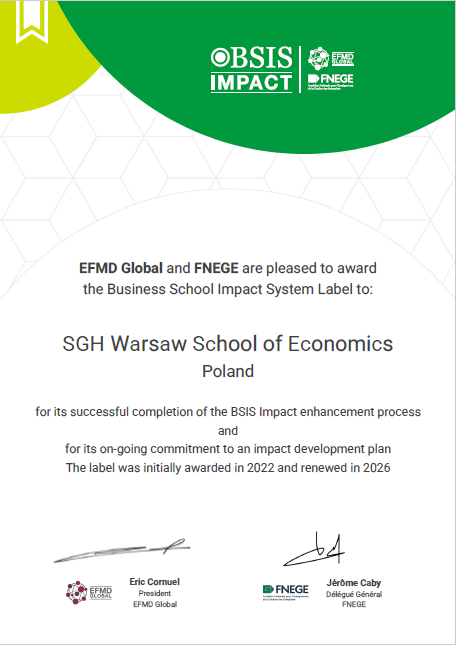
The SGH Warsaw School of Economics has renewed its BSIS Impact certification, awarded in 2022, which demonstrates the impact the institution has on its socio-economic environment.
The BSIS Label is a certification issued by the European Foundation for Management Development (EFMD), a global non-profit organisation dedicated to the development of management education.
EFMD is recognised worldwide as an accrediting body for business schools and their programmes. In the context of BSIS certification, EFMD collaborates with the Fondation Nationale pour l’Enseignement de la Gestion des Entreprises (FNEGE), a French expert foundation specialising in management education and research in the field of management sciences. FNEGE is EFMD’s substantive partner in the context of the BSIS certification methodology.
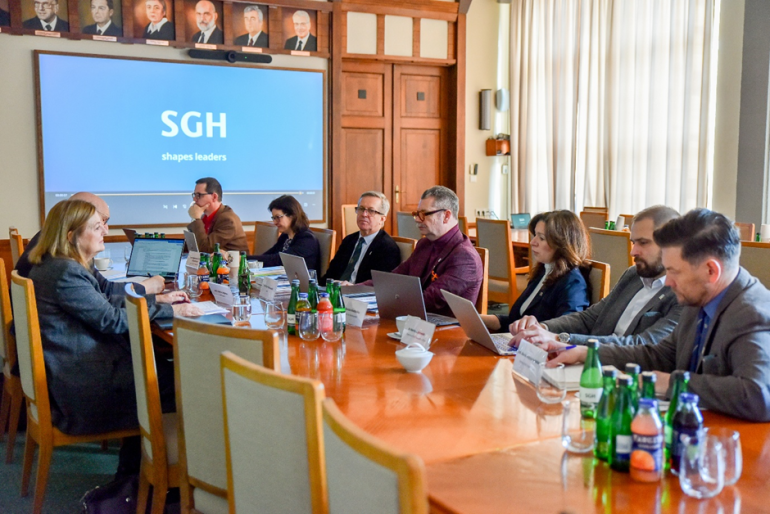
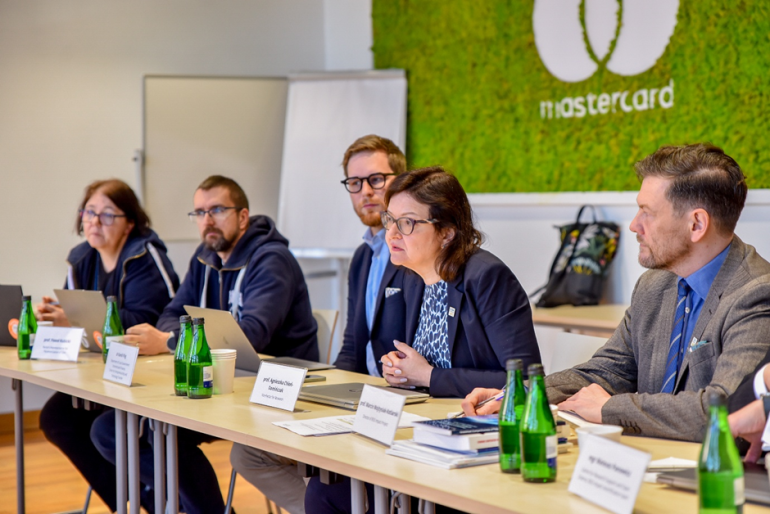
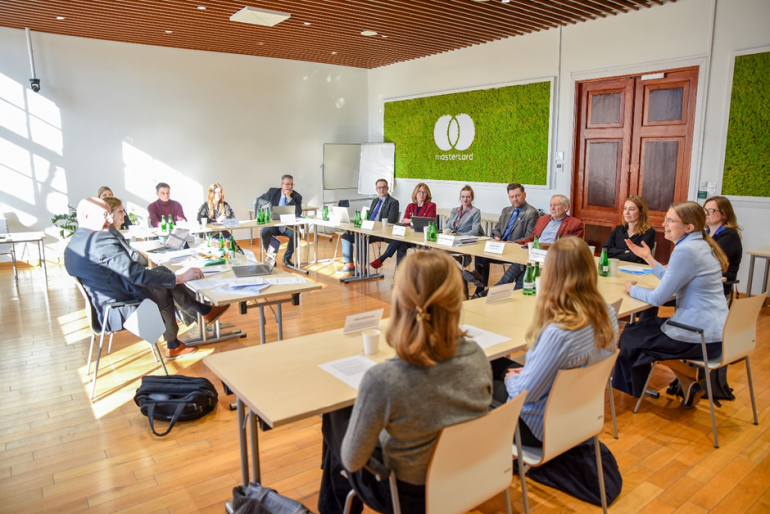
The evaluation committee that visited our campus on 5 and 6 March 2026 comprised two highly experienced experts: Prof. Debra Leighton, Higher Education Senior Advisor at EFMD Global, and Prof. Wilfried Niessen, Dean of HEC Liège, Belgium.
As part of the BSIS certification process, the impact of a higher education institution on its wider environment is assessed across seven dimensions: financial, educational, intellectual, social and reputational, as well as its impact on business development and the development of the regional ecosystem.
Financial impact:
• Both direct (the budget) and indirect (cost of living expenditures by students and participants).
• Quantifiable statistical data regarding money spent in the region by the school, by its employees, by its students, by visiting professors and by all those people who come to the campus in relation with the School’s activities.
Educational impact:
• Student admissions flow into the School’s degree programmes from the region, from the country at large and from abroad.
• Student flows into the job market within the region, within the country at large and into companies abroad.
• Managerial impact in the region of the school’s executive education programmes.
Business development impact:
• Impact on the economic development of the region: new business creation, services to established companies.
• Students as valuable resources for the local economy during their studies (internships, special missions in the home country and abroad, apprenticeships).
Intelectual impact:
• Impact upon the managerial community within the region through the intellectual output of the school’s faculty: publications, chairs, dissemination of new ideas and new managerial methods.
• Contribution to the cultural life of the community at large through conferences, public lectures, etc.
Impact within regional ecosystem:
• Involvement of the faculty and students in public life within the community.
• Integration of the school into the regional ecosystem of higher educational institutions, professional associations, public bodies and local authorities.
Societal impact:
• Existence of explicit policies in the area of CSR, sustainable development etc.
• Integration of these concerns in teaching, research and management of the school.
• Concern for diversity and equal access within all the school’s activities.
Image impact:
• Nature of the school’s local, national and international image.
• Contribution of the school to the image of the impact zone.
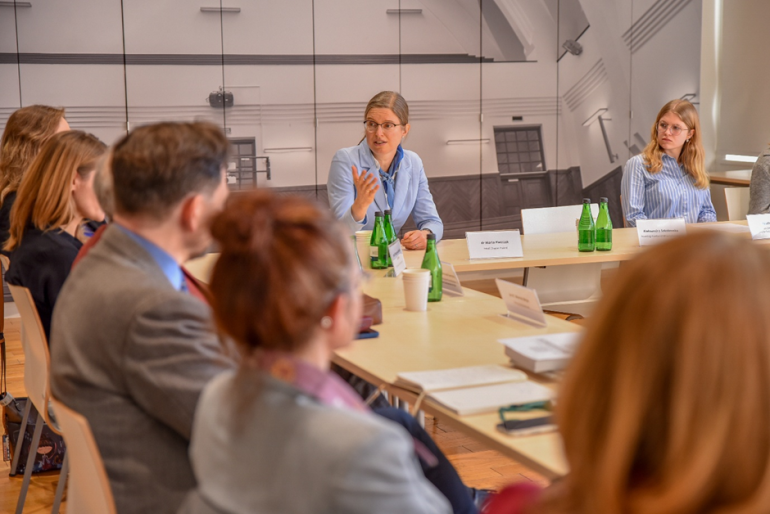
“Whilst during the EFMD experts’ first visit, prior to receiving the BSIS Impact certificate, we were assessed across all seven dimensions of impact on the environment, during the second visit, prior to recertification, we were able to select specific dimensions, and we chose four of them: intellectual, relating to the development of the regional ecosystem, social and reputational,” said Dr Marcin Wojtysiak-Kotlarski, Professor at the Warsaw School of Economics (SGH) and head of the university’s team for AACSB, EQUIS and BGA accreditation, as well as for BSIS certification, in an interview with Gazeta SGH-życie uczelni.SGH carried out a self-assessment process in the context of BSIS certification. The commission expressed its sincere thanks for the organisation of the visit and the preparation of high-quality documents prior to the visit. Our university was commended, among other things, for its distinct identity, recognisable expertise and strong national and international standing, built consistently over 120 years. Its tangible impact on the wider community was highlighted, including its ability to influence public policy on matters of importance to the region, Poland, and its role in Europe. Its extensive research, teaching and advisory output, commitment to sustainable development and ethical responsibility, and the conscious cultivation of a culture of measuring and communicating the university’s impact were also recognised.
Professor Wojtysiak-Kotlarski expressed his gratitude to everyone – academic staff, university administrative staff, as well as students, alumni and representatives of partner companies – who were involved in preparing the necessary documents ahead of the visit and in taking part in meetings with BSIS experts.
Dr Marcin Wojtysiak-Kotlarski is Head of the Department of International Strategy at the Institute of Management, College of Management and Finance, Warsaw School of Economics. The EFMD Foundation also awards EQUIS accreditation, which the Warsaw School of Economics received in 2021, with reaccreditation due in 2024.
BSIS IMPACT certification granted to SGH | Gazeta SGH
SGH earns EQUIS re-accreditation | Gazeta SGH