
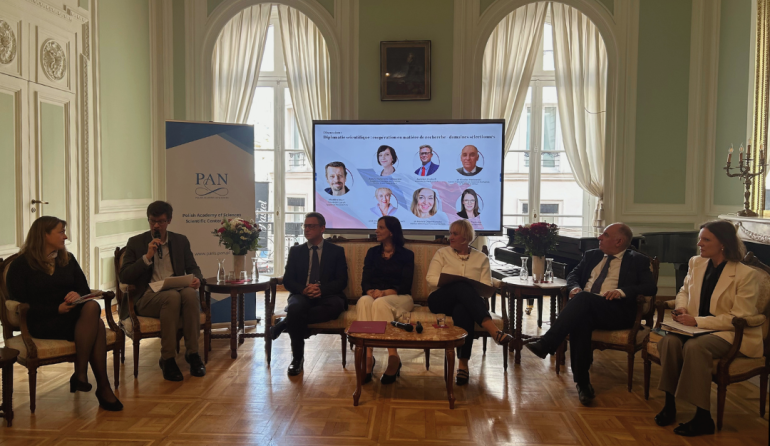
On 18–19 May 2026, the Polish Academy of Sciences Research Station in Paris hosted a conference entitled ‘Enhanced Polish-French cooperation in the light of the Treaty of Nancy: scientific diplomacy, security, migration’. The first day was devoted to migration, security and public communication. The PHC Polonium project “AMIPOL” was presented, analysing the politicisation and mediatisation of migration and their links to security, securitisation and hybrid threats. Researchers from the Sciences Po Aix, Sorbonne Nouvelle, the University of Lyon, the SGH Warsaw School of Economics and the University of Warsaw took part in the presentation. The second day of the conference focused on scientific and cultural diplomacy.
The opening lecture was delivered by Pierre Buhler, former French Ambassador to Poland, who discussed Polish-French relations in the context of the changing international order. He highlighted the pressure facing the post-war order based on international law, and the need to redefine European security. He highlighted the need for greater strategic autonomy for Europe and the special role of Poland as a frontline state. He described the Treaty of Nancy as a unique instrument of cooperation, the only one of its kind signed by France with a state not in its immediate neighbourhood.
In the section devoted to academic diplomacy, Kinga Torbicka, Assistant Professor at the Department of Strategic Studies and International Security, Faculty of Political Science and International Studies, University of Warsaw, highlighted three of its dimensions: resilience diplomacy, which utilises knowledge and expert networks to strengthen the capacity to
European security. He highlighted the need for greater strategic autonomy for Europe and the special role of Poland as a frontline state. He described the Treaty of Nancy as a unique instrument of cooperation, the only one of its kind signed by France with a country outside its immediate neighbourhood.
In the section on science diplomacy, Kinga Torbicka, Assistant Professor at the Department of Strategic Studies and International Security, Faculty of Political Science and International Studies, University of Warsaw, highlighted three dimensions of it: resilience diplomacy, which utilises knowledge and expert networks to strengthen states’ capacity to deal with crises; technological diplomacy, in which science supports a state’s position in areas such as cybersecurity; and scientific security, encompassing the protection of data, infrastructure and strategic knowledge.
Nicolas Maslowski from the French-speaking Centre for Humanities and Social Sciences in Vilnius highlighted the importance of academic institutions such as the Centre for French Culture at the University of Warsaw and the Centre for Polish Culture at the Sorbonne. He highlighted the untapped potential of scientific cooperation, which the Treaty of Nancy could strengthen through joint projects, exchanges and research networks.
Małgorzata Molęda-Zdziech from the SGH Warsaw School of Economics presented academic diplomacy primarily as a space for dialogue. She pointed out that science facilitates dialogue across political boundaries and enables research findings to be used to tackle the complex problems of the modern world (climate change, migration, multiple crises). She also mentioned the importance of the European Research Area and cited examples of Polish-French cooperation, such as the PHC Polonium AMIPOL project, which focuses on the mediatisation and politicisation of migration.
Aldona Jankowska from the Polish Academy of Sciences Scientific Centre in Paris, meanwhile, drew on experiences in medicine, citing paediatric oncology as an example of an area where international cooperation enables the harmonisation of treatment standards, the comparison of results, and the development of more effective therapeutic methods.
Mariola Odzimkowska from the Polish Library Institute in Paris discussed the role of the Polish Library Institute in Paris as a venue for interdisciplinary dialogue and trust-building. She emphasised the importance of cultural diplomacy and highlighted challenges such as the decline in French language proficiency among Polish researchers.
The second part of the meeting presented European university alliances as a dynamic form of academic diplomacy. Aurelien Krejbich from Sciences Po Paris, CIVICA, discussed the development of the European Universities initiative, comprising 65 consortia, including 26 involving Polish and French universities. Particular mention was made of CIVICA and 4EU+, which strengthen the European education area, mobility and academic cooperation.
The conference demonstrated that scientific and cultural diplomacy, as part of public diplomacy, is an important tool for deepening Polish-French relations against a backdrop of growing geopolitical tensions. Science, education and culture strengthen the resilience of nations, build trust and foster European cooperation. The Treaty of Nancy provides the political framework, whilst academic and cultural institutions give it practical substance through projects, consortia and expert networks.
The conference was moderated by Szymon Łucyk, Polish journalist working with “Tygodnik Powszechny”. The event was organised by: the Polish Academy of Sciences Scientific Centre in Paris, the Warsaw School of Economics (SGH), and the Faculty of Political Science and International Studies at the University of Warsaw. The event was held under the patronage of, amongst others, the Polish Embassy in Paris and the Ministry of Science and Higher Education. Information about the event was published by PAP and on the “Nauka w Polsce”.