
Joint statement by more than 260 European institutions, including SGH Warsaw School of Economics
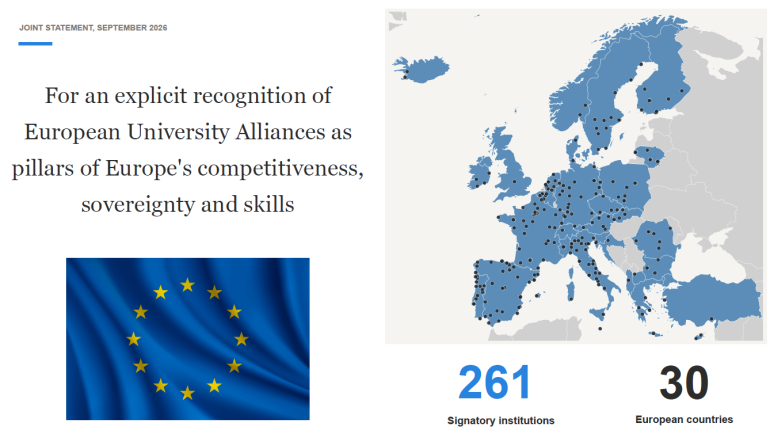
261 institutions from 30 European countries, including SGH Warsaw School of Economics, released a joint statement “For an explicit recognition of European University Alliances as pillars of Europe's competitiveness, sovereignty and skills” calling on the Council of the European Union and the European Parliament to acknowledge the role of the Alliances in the 2028-2034 Multiannual Financial Framework and in the European Competitiveness Fund. Below is the text of the statement and a list of the institutions that signed it.
We, the Presidents and Rectors of universities that are members of European Universities alliances, wish to reaffirm the collective role played by European universities in addressing the major crises Europe has faced in recent years, whether in strengthening the resilience of our Union during the COVID-19 pandemic or in supporting Ukraine since the Russian military aggression. In line with the vision and recommendations articulated by France Universités and the FOREU4ALL Community of Practice, we reaffirm our commitment to contributing to the development and strengthening of the European Education Area, the European Higher Education Area, and the European Research Area, and to fostering the skills that will enable us to educate the outstanding talents of tomorrow, i.e. individuals capable of meeting global industrial, technological, social, and environmental challenges by drawing on the latest scientific advances.
As highlighted in the FOREU4ALL Discussion Paper, European Universities alliances are pioneering new models of deep collaboration across borders, reducing fragmentation, connecting regional innovation ecosystems, and advancing the free circulation of knowledge and innovation across Europe. As pillars of the Union of Skills and Innovation across all territories, European universities are indispensable to achieving the objectives of the Competitiveness Compass and to delivering the Fifth Freedom of the Single Market for knowledge and innovation. If Europe is to strengthen its independence and sovereignty in relation to other major global powers, it cannot do so without the capacity of European universities to support local and regional economic development, strengthen European values and identity, and to help bridge the disparities. We therefore call on the Council of the European Union and the European Parliament, which are responsible for adopting the European Union’s 2028–2034 Multiannual Financial Framework and programmes, to explicitly acknowledge and support the role and potential of the European Universities alliances in the legislative texts currently under discussion.
The 30 countries represented Austria, Belgium, Bulgaria, Croatia, Cyprus, Czech Republic, Denmark, Finland, France, Germany, Greece, Iceland, Ireland, Italy, Lithuania, Malta, Netherlands, North Macedonia, Norway, Poland, Portugal, Romania, Slovakia, Slovenia, Spain, Sweden, Turkiye and Albania, Switzerland, United Kingdom.